Before the Genome, There Was the Patient: How the Discovery of AIDS Reminds Us What Medicine Risks Forgetting
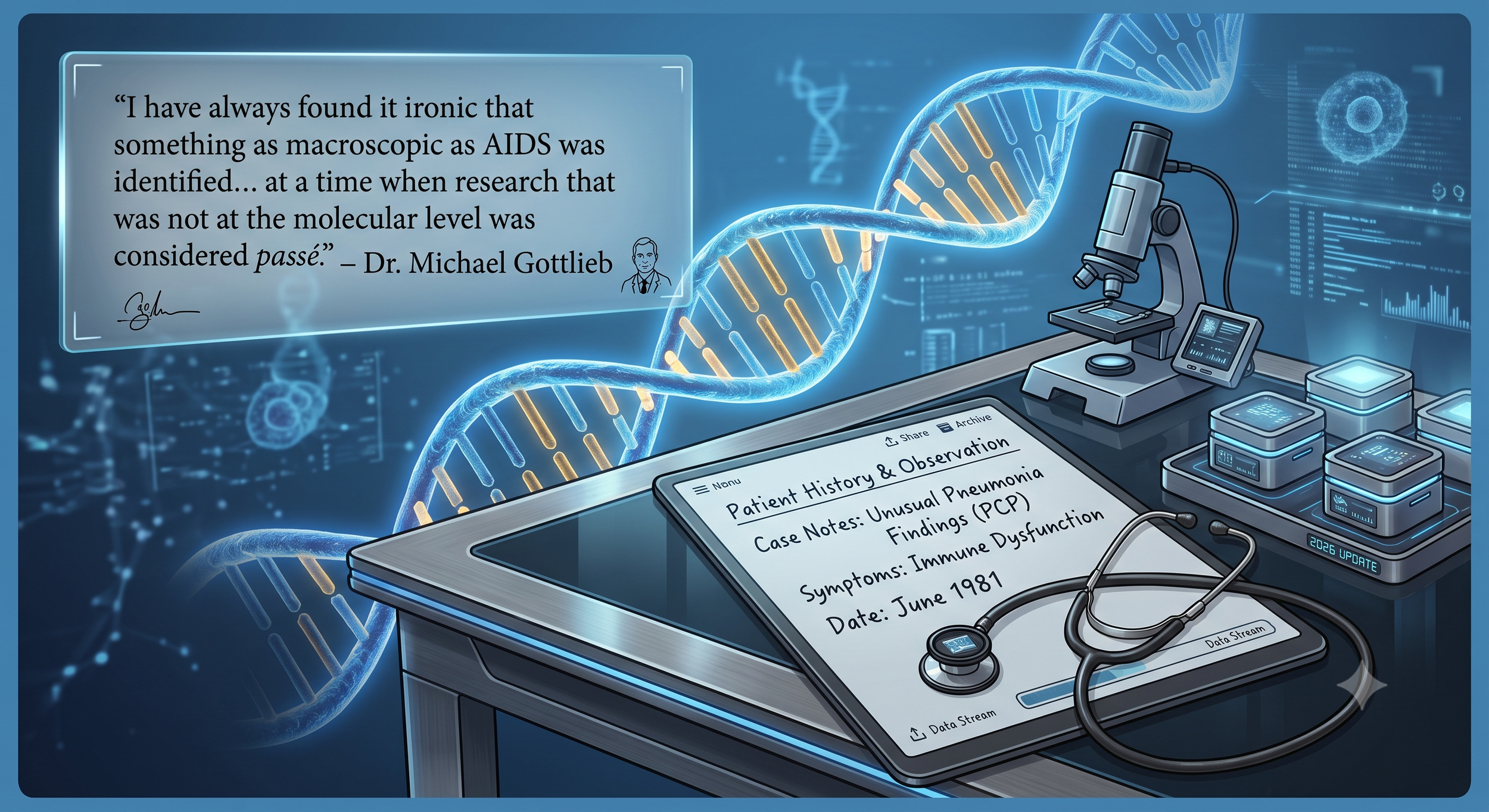
“I have always found it ironic that something as macroscopic as AIDS was identified at a university hospital at a time in academic medicine when research that was not at the molecular level was considered passé.”
— Dr. Michael Gottlieb, Epidemiology
That observation from Michael Gottlieb has stayed with me for decades because I know exactly what he meant.
One of the most important medical discoveries of my lifetime, the discovery of AIDS, began not with genomics, artificial intelligence, or sophisticated molecular tools. It began with a physician paying close attention to what was happening in front of him with an unusual and often fatal form of pneumonia: Pneumocystis carinii pneumonia. What immediately struck him was not only the rarity of the condition, but the fact that all five patients were previously healthy young homosexual men with severe immune dysfunction that made no clinical sense.
Michael became lead author of the now historic June 5, 1981 CDC Morbidity and Mortality Weekly Report describing those cases. Shortly afterward came the landmark New England Journal of Medicine paper: Pneumocystis Carinii Pneumonia and Mucosal Candidiasis in Previously Healthy Homosexual Men — Evidence of a New Acquired Cellular Immunodeficiency.
That was the first clear description of what became known as AIDS.
To me, it remains one of the greatest examples of clinical observation in modern medicine.
What makes the story especially meaningful to me is that Michael and I grew up together.
We attended Rutgers Preparatory School together from seventh grade through high school. We were both biology majors at Rutgers College and members of the Phi Epsilon Pi fraternity. His father, Art Gottlieb, had been a football star at Rutgers before becoming a coach, and the Gottlieb family was part of the same New Jersey world in which I grew up.
Michael always looked polished and put together. I decidedly did not.
When Michael visited our house during high school, my maternal grandmother would sometimes look at him admiringly and then point toward me with my chaotic hair and wrinkled shirt and ask my mother, “How is it that Michael Gottlieb looks like this and your boys look like that?”
She had a point.
Michael went on to the University of Rochester School of Medicine before completing training in Internal Medicine at Strong Memorial in Rochester, NY. I somehow found my way into Yale School of Medicine, stayed in New Haven for psychiatry residency training, and eventually joined the Intramural Research Program at NIMH in Bethesda.
At the time Michael identified AIDS, academic medicine was already becoming increasingly dominated by molecular biology. Research that did not operate at the molecular level was often considered old-fashioned, unsophisticated, or somehow less important.
And yet one of the defining medical discoveries of the twentieth century emerged from bedside observation.
Psychiatry experienced something remarkably similar decades earlier.
One of the most consequential discoveries in psychiatric history also began with clinical observation rather than theory. In 1951, chemist Paul Charpentier synthesized chlorpromazine while searching for new antihistamines at Rhône-Poulenc laboratories in France. Henri Laborit, a French military surgeon, used the drug in surgical patients and noticed something unusual. Patients developed a curious emotional “disinterest” without losing consciousness.
That observation caught the attention of psychiatrists Jean Delay and Pierre Deniker at Sainte-Anne Hospital in Paris. When they administered chlorpromazine to patients with schizophrenia, they observed something extraordinary: the drug did not merely sedate patients. It reduced hallucinations, delusions, and psychotic symptoms themselves.
Modern psychopharmacology was born.
Having spent years directing the NIMH schizophrenia research ward at the NIH Clinical Center, I know firsthand what it is like to watch psychosis improve in an otherwise drug-free patient receiving antipsychotic medication. Even today, it can feel remarkable. I can only imagine what it must have been like to witness this effect for the first time in the early 1950s.
Chlorpromazine (Thorazine) transformed psychiatry. State hospital populations declined dramatically. Some institutions eventually closed altogether. It was one of the most important therapeutic advances in all of medicine.
And again, the breakthrough began with careful clinical observation.
Throughout my years at NIMH, I learned that observation remains the foundation of medicine, even when institutions become captivated by technology. Brain imaging, neurochemistry, and genomics have all contributed important pieces to our understanding of schizophrenia, but none has yet provided a definitive explanation for its pathophysiology.
What consistently told us whether a patient was improving, deteriorating, or responding to a new treatment was careful, quantified clinical observation.
Unfortunately, as genomics became increasingly dominant at NIH and elsewhere, direct clinical investigation gradually lost prestige. Long before the current Trump administration, there were already no inpatients with schizophrenia being studied at the NIH Clinical Center.
That reality still troubles me.
While researching this essay, I came across Michael’s 1988 editorial again. His words resonated even more strongly now than they did when I first read them years ago.
“I have always found it ironic that something as macroscopic as AIDS was identified at a university hospital at a time in academic medicine when research that was not at the molecular level was considered passé.”
Michael, I know exactly what you mean.
I had a brief encounter with another figure who would soon become central to the AIDS story. During my first year as a fellow at NIMH, I provided a psychiatric consultation for a young scientist at the National Institute of Allergy and Infectious Diseases. His name was Anthony Fauci.
At the time, Dr. Fauci was studying a disease I had never heard of before or since: lethal midline granuloma. He was not yet famous, but even then he projected enormous intensity and focus. He had the unmistakable drive of someone determined to win.
Michael Gottlieb identified AIDS through clinical observation. Tony Fauci would later help lead the massive scientific and public health response that followed.
Both roles mattered.
At one point in my own career, I imagined I might someday make a major clinical observation of my own. Perhaps every physician-scientist secretly hopes for that. I had a few observations that mattered, though only on my own scale.
Now, at this stage of life, I find myself hoping for something slightly different.
I hope someone eventually attacks schizophrenia with the same intensity, urgency, and scientific ambition that AIDS researchers brought to HIV decades ago.
Because despite all of our technological sophistication, psychiatry still desperately needs people willing to look carefully at patients, trust what they observe, and follow the evidence wherever it leads.